The Ancient Kingdom Route
A twelve-day route through Sri Lanka's ancient capitals, taken in the order they were built — Anuradhapura to Polonnaruwa to Kandy, then up into the tea country.
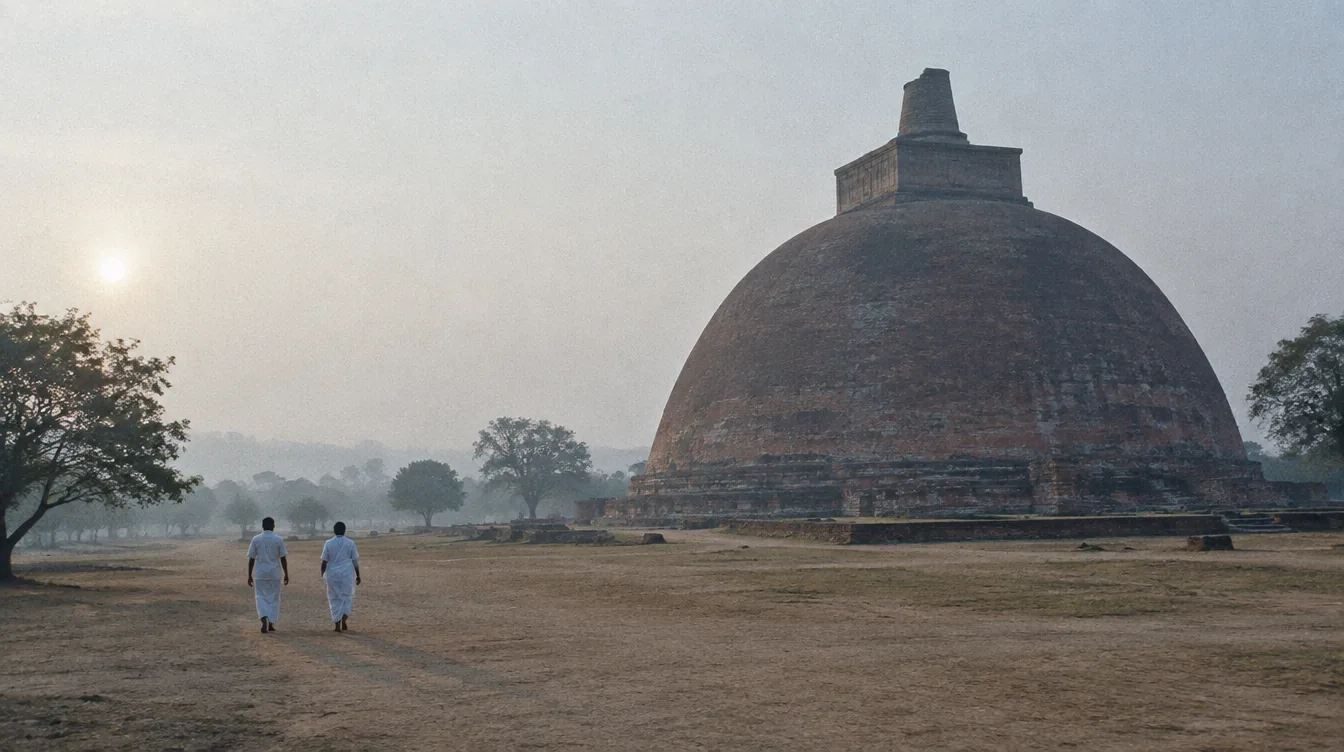
This is the route we build most often, and the thing that makes it work isn’t the list of sites. Everyone visits the same four. It’s the order, and the gaps between them.
Sri Lanka’s capitals moved south over fifteen centuries, each time the last one fell. Anuradhapura first, for over a thousand years. Then Polonnaruwa. Then, eventually, Kandy. Travel in that direction and each place explains the one after it. Travel the other way — which is the more common routing, because Kandy is closer to Colombo — and you spend the fortnight assembling the story backwards.
The second thing is pace. These are hot, dusty, largely unshaded sites in the dry zone, and the surest way to ruin them is three on consecutive afternoons. Nothing in this route moves on after a single night, and every day is built around being out early and finished before the heat arrives.
The shape below is what we’d propose. Yours will differ — the hotels, where the rest days fall, whether you want the train leg or would rather drive it — but the sequence is the part we’d argue for.
How it actually runs.
- Day 1
Land, and do nothing
Most flights from the UK land before dawn after a night with very little sleep. The temptation is to start immediately — the Cultural Triangle is four hours north and the day is technically still ahead of you. Don't. We keep the first night within half an hour of the airport, and the only plan is a swim and an early dinner. It costs you nothing on a twelve-day trip and it changes the first week.
Stay A quiet hotel close to the airport — not in Colombo
- Days 2 – 3
Anuradhapura, where it starts
The oldest capital, and the one most itineraries skip because it's furthest from everywhere. It held power for over a thousand years, and what's left is spread across some forty square kilometres rather than gathered into a site. Most people cover it by bicycle or tuk-tuk — it's a twenty-odd kilometre loop and far better than doing it in a car. Two nights, because one means seeing a third of it. We start at six both mornings. The sacred bo tree, grown from a cutting of the one the Buddha sat under, still has pilgrims in white arriving at first light, and that hour is the reason to be here rather than the architecture.
Stay Small hotel outside the sacred city, near the tank
- Days 4 – 6
Sigiriya, Dambulla and a day out to Polonnaruwa
One base for three nights, which is the part worth arguing for. Most routes give Polonnaruwa its own overnight and you end up packing twice in three days for no gain — it's an easy day trip from here and much better done as one. Sigiriya at six, Pidurangala the following dawn. Sigiriya is the site itself: the frescoes, the mirror wall, the water gardens. Pidurangala is the rock opposite, cheaper and quieter, and the place you actually photograph Sigiriya from. Dambulla's painted caves fill an afternoon. Polonnaruwa is flat and compact enough to do by bicycle, and Gal Vihara — four colossal Buddhas cut from one granite face — is the single finest thing in this itinerary.
Stay Three nights in one place, with a pool for the middle of the day
- Day 7
The road south
The drive to Kandy is the first long one of the trip, and it climbs the whole way. We break it — Matale, a spice garden if you want one and none if you don't, and lunch somewhere that isn't a coach stop. You arrive in the late afternoon, which is the right time to see the lake for the first time.
Stay Above the town, looking down at it
- Days 8 – 9
Kandy, the last kingdom
The final capital, and the only one that's still a working city rather than a ruin — which after a week of archaeology is a considerable relief. The Temple of the Sacred Tooth Relic is best during a pooja, when the drumming starts and the inner chamber opens, rather than in the flat middle of the day. Beyond the temple there's the botanical gardens at Peradeniya, the market, and a lake you can walk around in an hour. Two nights here is the minimum. Three if you'd rather not rush the tea country afterwards.
Stay Colonial-era house or a small hotel on the ridge
- Days 10 – 11
Up into the tea
The road out of Kandy climbs into cloud within an hour, and the change is abrupt — you go from needing a fan to needing a jumper in a single morning. This is the part of the trip nobody expects to be their favourite and frequently is. A working estate rather than a museum, a factory that still runs, and afternoons that are properly cold. The train leg from Kandy is optional and we'd usually say do half of it — the celebrated scenery is concentrated in the last stretch, and the first two hours are slower than the car without being more interesting.
Stay Tea bungalow — six rooms, a fire lit at dusk
- Day 12
Down to the coast, or home
The drive back to the airport is long from the hill country, so this is a travelling day rather than a sightseeing one. Most people would rather not end a trip that way — if you have three or four nights spare, this is where a coast goes, and which coast depends entirely on the month. December to March, the south. From May, the east.
Before you commit to this shape.
Want this one, shifted to your dates?
A few short questions, one of our team on the other end. Reply within 48 hours — no funnels, no call centres, no auto-replies pretending to be people.