Short drives. Very different days. Nobody in tears by Thursday.
Family trips to Sri Lanka planned around what children can actually manage — short drives, real variety, and honest advice about what won't work at your kids' ages.
Why this country is easier with children than people expect
Three things, and none of them are the ones in the brochures.
The distances are short. You can see elephants in the morning and be somewhere with a pool by mid-afternoon. In most countries offering this much variety, the variety is three hundred kilometres apart.
The food isn’t a battle. A Sri Lankan table isn’t uniformly hot — there are always mild dishes, and kitchens are relaxed about cooking something plain. Add eggs, fruit, bread and noodles everywhere and the thing parents worry most about mostly evaporates.
Children are genuinely welcome. Not tolerated — welcomed. Staff will talk to your children, carry them about, take them to see the kitchen. This is a real cultural difference from most holiday destinations and it changes how a fortnight feels.
What actually ruins family trips here
Long drives. Everything else is recoverable. A four-hour transfer with tired children sets the tone for two days, and it’s nearly always the result of a badly sequenced route rather than an unavoidable distance.
Too many temples in a row. The Cultural Triangle is remarkable and it’s also three ancient cities of hot stone. One is memorable. Three consecutively is a punishment, and the children will make sure you know it.
The middle of the day. It’s hot. Plans made without a gap between eleven and three don’t survive contact with an eight-year-old.
An over-ambitious first week. Jet lag plus heat plus somewhere unfamiliar takes a few days to absorb. We front-load the easy things and save the early starts for when everyone’s adjusted.
A shape that tends to work
Somewhere within reach of the airport for the first night, so nobody drives tired. Then a few days with a pool and low expectations while everyone adjusts. Wildlife next, while enthusiasm is still high. A train leg in the middle, because it breaks up the driving and children like trains considerably more than they like scenery. Then the coast for the rest of it, in one place, not moving.
Two bases for ten days, three for a fortnight. Fewer than you’d think.
How we choose where you stay
With children the filter is different, and it isn’t really about luxury.
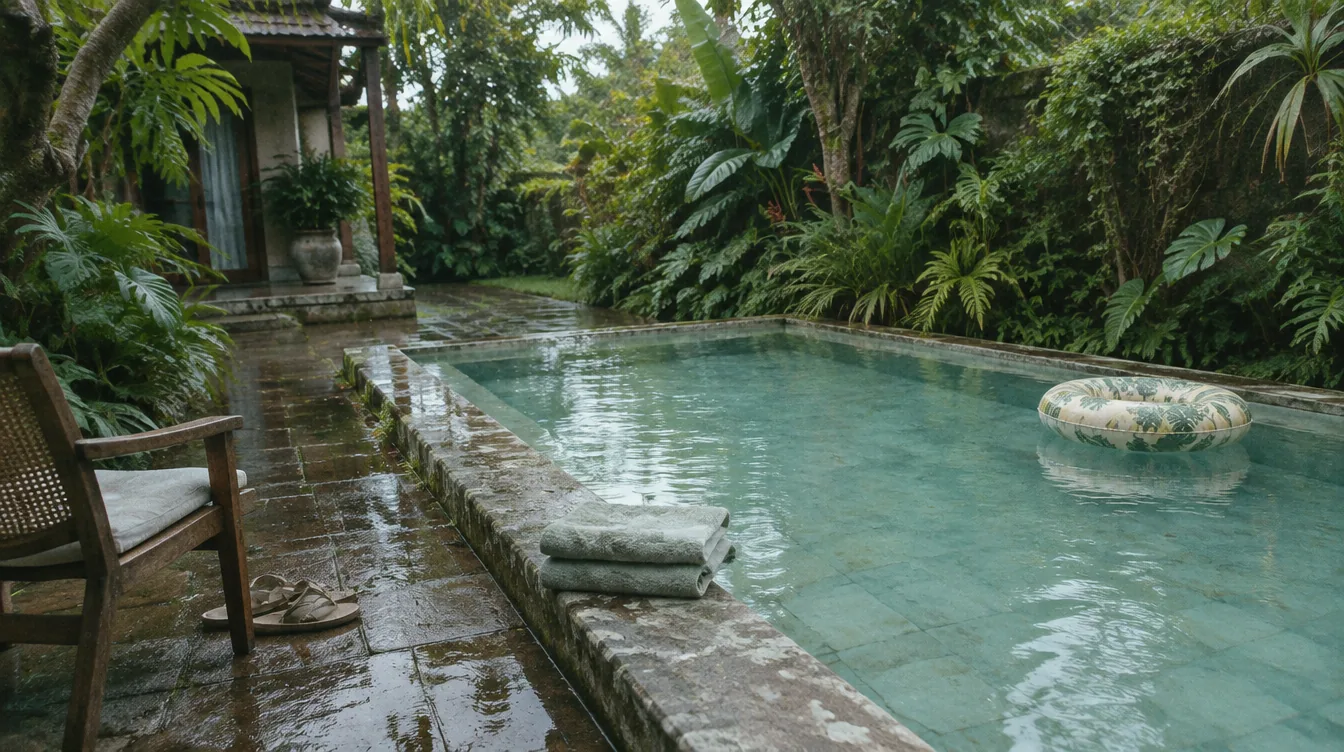
We’re looking at the pool — whether there’s a shallow end or it’s uniformly deep, which decides whether you get to sit down. At the layout, because a room where a baby can sleep while the adults are still awake is worth more than a better view. At whether the grounds are enclosed, and how far from the water the building sits. At the beach itself, because several of the prettiest stretches on this island have a current you wouldn’t put a seven-year-old in, and that is not visible in a photograph.
And at whether the kitchen will actually cook plain rice at six o’clock without making it a problem.
You’ll get options with the trade-offs said out loud — the one with the better pool but the longer drive, the one that’s perfect in February and wrong in July.
What we actually do
We know how the country moves with children in the car. Which drive is four hours rather than the two it looks like. Which park gives you elephants with near-certainty when a leopard would be a gamble. Which train leg is a highlight and which is three hours of complaining. Which week the sea on a given coast turns rough.
We’ll also tell you when something won’t work. If your youngest is three and you want the full Cultural Triangle, we’ll say so and suggest a better version — we’d rather design the right trip than the impressive-sounding one.
While you’re travelling there’s one person to contact, in the same time zone as your trip.
The questions worth asking first.
Tell us your dates.
We'll tell you which coast.
A few short questions, one of our team on the other end. Reply within 48 hours — no funnels, no call centres, no auto-replies pretending to be people.